Competition Insights
Everything you need to know to get the most out of your swimming in training, at galas, and at home.
Training Advice
Parent Advice
Working Together
Training Advice
Training what we do and why
Every session your coach sets is designed with a purpose. Understanding that purpose helps you train smarter, not just harder.
Why we do different types of sessions
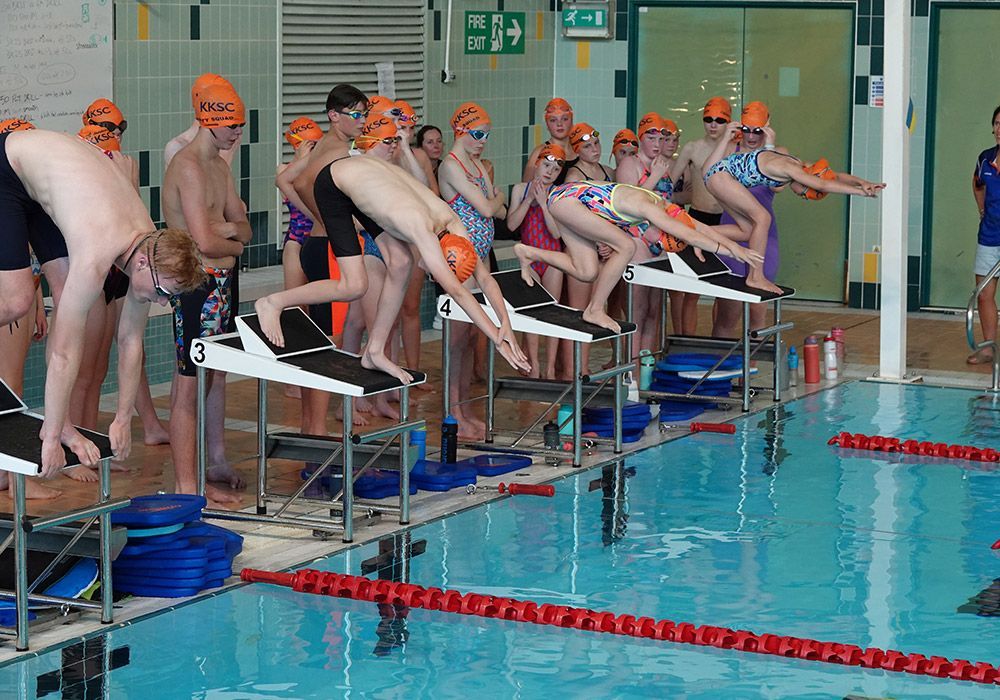
Your body has three energy systems think of them as three different engines. We use different types of training to develop each one:
- Short, explosive speed (sprints, starts, fast 15m efforts) trains your fastest engine the one that fires in the first few seconds of a race.
- Hard race-pace sets think 50m to 100m efforts — train your middle engine, the one that powers you through a fast race. You'll feel this one as the burn in your arms and legs.
- Longer, steadier aerobic sets build your biggest engine. This is the foundation everything else sits on. The more aerobic base you have, the faster and longer you can go.
This is why we don't just do sprints all the time — and why the long steady sets matter just as much as the fast ones. Every part of the session has a reason.
Training cycles
We run three training cycles per year: September to Christmas, January to Easter, and Easter to summer. Each cycle follows a similar pattern we build aerobic fitness first, then layer in faster, harder work as the cycle progresses. At the end of each cycle, we taper and sharpen up for the main competition.
Within each week, hard sessions are followed by easier recovery sessions. Skipping the easy ones makes the hard ones harder than they need to be.
Better understanding = better training = better racing.
Fuelling your swimming
What you eat and drink directly affects how well you train and race. This doesn't mean being obsessive about food it means being sensible about it.
Every day
Aim for a balanced diet built around carbohydrates (pasta, rice, bread, potatoes, oats), protein (meat, fish, eggs, beans), fruits and vegetables, and plenty of water. Carbohydrates are the fuel your muscles run on don’t skip them.
Around training
- Before: eat something 30–60 minutes before a session a banana, some toast, a bowl of cereal. Don't train on empty.
- During: bring a drink. Water or diluted juice is fine. You lose more fluid than you think in the pool.
- After: eat within an hour of finishing a proper meal with carbs and protein. This is when your body recovers and rebuilds.
On race day
Stick to what you know. Race day is not the time to experiment.
- Eat a carb-based meal at least 2 hours before your first event -pasta, cereal, toast, bagels.
- Between events with less than an hour's wait: keep it small - banana, crackers, juice.
- Between events with 2–4 hours: a light meal is fine- sandwich, fruit, a small bowl of cereal.
- Avoid fatty food before competing (chips, a full cooked breakfast). It sits heavily and slows you down.
- After the session, eat a proper meal - especially if you're competing again the next day.
Good snacks for meets bananas, sandwiches, oat bars, rice cakes, raisins, bagels, malt loaf, fruit. Save the sweets for after the last race.
Parent Advice
For parents — how to support your swimmer
You play a massive role in your child's experience of the sport. The good news is that the best thing you can do is also the simplest: be there, be positive, and let the coaches do the coaching.
The one question that matters
"Did you enjoy it?"
That's it. After every session and every race, that's the question that matters most. Not what place they came, not whether they got a PB, not what went wrong. Enjoyment is what keeps young swimmers in the sport long enough to get good at it.
At training
- Drop off and trust the process. Your child is in good hands.
- Don't coach from the side. Even well-meant technical advice can conflict with what the coaches are working on and create confusion.
- Celebrate effort, not just results. A swimmer who trains hard every week is doing something right, regardless of what the clock says.
At galas
- Cheer loudly. Genuinely - our swimmers love the noise.
- Cheer for all the Kingfishers, not just your own child.
- After the race: "Well done" first, always. If there's something to learn from it, that's the coach's job, not the poolside debrief.
- Don't criticise officials or other clubs. It sets a tone the kids pick up on.
At home
- Help with the practicalities - kit ready, good food, early nights before big sessions.
- Let your child own their swimming. Their goals are theirs, not yours.
- If your child is nervous before a competition, acknowledge it. Don't dismiss it. Nerves are normal - the coaches wouldn't enter them if they weren't ready.
- If your child wants to quit, listen before reacting. Sometimes it's a bad week. Sometimes it's something real. Either way, a conversation goes further than pressure.
A quick check-in
It's worth asking yourself occasionally: whose goals am I focused on — mine or my child's? Is my reaction after a race about how they feel, or how I feel? The parents who have the best experience in this sport are the ones who are genuinely there for their child - not the result.
Working Together
The bigger picture
Swimming teaches young people things that last well beyond the pool: discipline, resilience, how to lose well and win graciously, how to be part of a team. Those qualities take years to develop. They don't come from a single great result - they come from showing up, week after week, and doing the work.
Progress in swimming is not linear. Swimmers improve in bursts, plateau, sometimes appear to go backwards, and then suddenly click again. That's normal. Trust the process and trust the coaches.
What the research tells us
Young swimmers develop best when three things are in place: they feel capable and improving, they feel connected to their teammates and coaches, and they feel that their choices and effort actually matter. Parents and coaches both play a role in nurturing all three and undermining any one of them can stall a swimmer's development, even when results look fine on the surface.
The coach–athlete–parent triangle
Swimming works best when coaches, swimmers and parents are all pulling in the same direction. The coach provides the technical expertise and the plan. The swimmer does the work. The parent provides the emotional support, the logistics, and the safe place to return to at the end of the day. Each role matters. The best clubs are ones where everyone knows which role they're in.
Olympic medallist
"My goal was to set a world record. Well, I did but someone else did it too, a little faster. I achieved my goal and I lost. Does this make me a failure? No, I'm very proud of that swim."
If you have any questions about training, competition or supporting your swimmer, talk to the coaching team. We're always happy to help.
You can download our Gala Guide here.